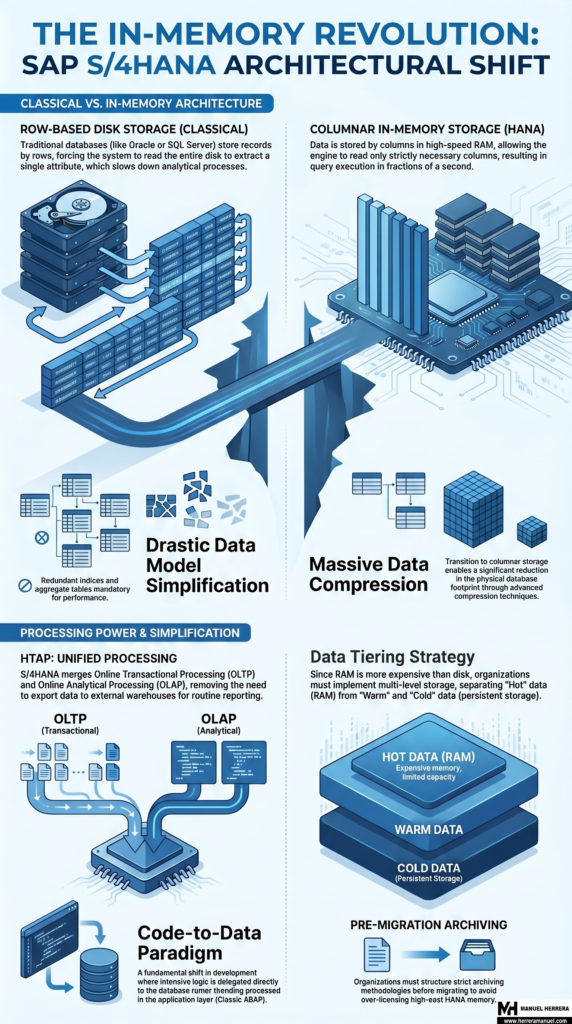
The transition to SAP S/4HANA represents a fundamental shift in the architecture of Enterprise Resource Planning (ERP) systems. At the heart of this transformation is the adoption of SAP HANA, a column-oriented database that operates entirely in RAM, eliminating the historical latency associated with storage on magnetic disks. This change enables the implementation of hybrid transactional and analytical processing (HTAP), unifying OLTP and OLAP functions on a single platform. The resulting architecture not only accelerates query performance but also drastically simplifies the data model by eliminating indexes and aggregate tables. However, the high cost of RAM demands rigorous data management strategies, such as data tiering and archiving prior to migration, as well as a paradigm shift in programming toward the code-to-data model.
In-Depth Analysis of Key Topics
1. Architecture Evolution: From Disk to RAM
Historically, ERP systems have been limited by the speed of physical storage media.
– Classic Architectures: Systems like Oracle or SQL Server store records row by row. In this model, to extract a single attribute, the system must read the entire disk, which severely penalizes analytical processing (OLAP).
– The In-Memory Solution: SAP HANA reverses this principle by storing data in high-speed volatile memory. This allows the engine to read only the columns strictly necessary for a query.
2. HTAP Processing and Operational Unification
One of the most relevant technical milestones described is SAP HANA’s ability to execute HTAP (Hybrid Transactional/Analytical Processing).
3. Data Model Simplification and Footprint Reduction
In-memory architecture and columnar storage necessitate a restructuring of both physical and logical data storage.
4. Economic Challenges and Multi-Tiered Management (Data Tiering)
Despite operational advantages, RAM presents a higher computational and economic cost than physical disk storage.
5. Development Paradigm Shift
Code-to-Data: Implementing SAP HANA is not just a hardware upgrade; it requires a transformation in how enterprise software is built.
Conclusions
The technical study concludes that SAP HANA redefines the processing of large volumes of data through a profound algorithmic and architectural restructuring. Eliminating disk storage as a bottleneck and adopting columnar structures enables previously unattainable levels of efficiency.
For further methodological models that evaluate the impact of these infrastructures on migration processes, consult specialized resources at www.herreramanuel.com.