The transition from SAP ECC systems to S/4HANA represents a critical turning point for global corporations. Analysis of industry case studies reveals that the accumulation of custom developments, known as Z Code, is the primary predictor of failure, cost overruns, and schedule extensions in ERP modernization projects. The clash between legacy code and the new, simplified data structures of S/4HANA demands a paradigm shift toward Clean Core and the adoption of extensibility architectures. Ignoring technical debt in the pre-contractual phases not only negates the return on investment but also perpetuates business inefficiencies under a socio-technical failure that can compromise operational stability in cloud environments.
Analysis of Key Issues
1. Technical Debt and Legacy Code
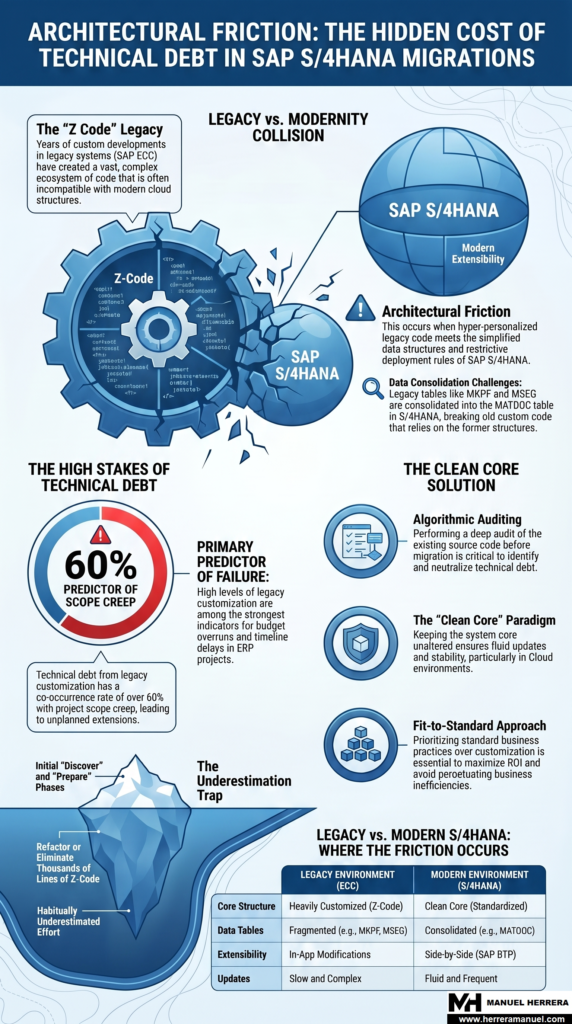
For decades, organizations have used SAP ECC as a highly customized platform to fill functional gaps. This wealth of customization has generated «technical debt» that becomes acutely apparent during migration processes.
* Origin of the Conflict: Hyper-customized Z code directly conflicts with the constraints of modern cloud deployments and simplified data structures.
* Underestimation of Effort: Typically, the effort required to review, adapt, or remove thousands of lines of code is underestimated during the initial project phases (Discover and Prepare).
* Structural Obsolescence: Many customizations attempt to interact with tables that have been eliminated or consolidated in the new architecture.
2. The «Clean Core» Paradigm and Extensibility Architecture
In contrast to the rigidity of legacy code, SAP S/4HANA promotes a clean core philosophy to ensure system agility.
* Definition of Clean Core: It consists of keeping the system core unchanged to allow for smooth and stable updates, an essential condition in cloud environments.
* SAP BTP (Business Technology Platform): Necessary adaptations must be moved to extensibility architectures external to the core, using platforms such as SAP BTP to preserve the integrity of the standard system.
* Data Simplification: A critical example of architectural evolution is table consolidation.
– Previously (ECC): Tables like MKPF and MSEG managed inventory data.
– Currently (S/4HANA): These tables have been consolidated into a single table called MATDOC.
3. Impact on the Success of Megaprojects
System customization is not only a technical challenge but also a variable with high predictive power regarding the project’s financial and timeline outcomes.
| Impact Variable | Findings in the Literature and Case Studies |
| Predictive Power of Failure | Technical debt due to customization has a co-occurrence rate exceeding 60% with scope creep. |
| Financial Consequences | Significant budget deviations and the need to extend external consulting contracts. |
| Chronological Impact | Critical delays in go-live due to the complexity of unplanned refactoring. |
Conclusions and Strategic Recommendations
Prior Algorithmic Audit
The document warns that it is «reckless» to undertake purely technical migrations (such as system conversions or brownfield projects) without first conducting a thorough algorithmic audit of the existing source code. Replicating outdated customizations in the new environment is a counterproductive practice that negates the competitive advantages of S/4HANA.
The Fit-to-Standard Approach
Technical debt should be treated as a socio-technical failure, not simply an IT problem. Addressing this debt should occur in the pre-contractual phases, always prioritizing the adoption of industry-standard best practices.
Foresight and Diagnosis
To mitigate the identified risks, the following future developments are proposed:
1. Empirical diagnostic matrices: Tools for volumetrically evaluating Z code before defining the deployment strategy.
2. Early diagnostic tools: The use of scientific methodologies and audits to reduce deviations.
*Referenced in specialized research such as that found at: www.herreramanuel.com.
In conclusion, the success of the transition to S/4HANA depends on the organization’s ability to move away from excessive customization and embrace an operating model aligned with the modern technological standard.