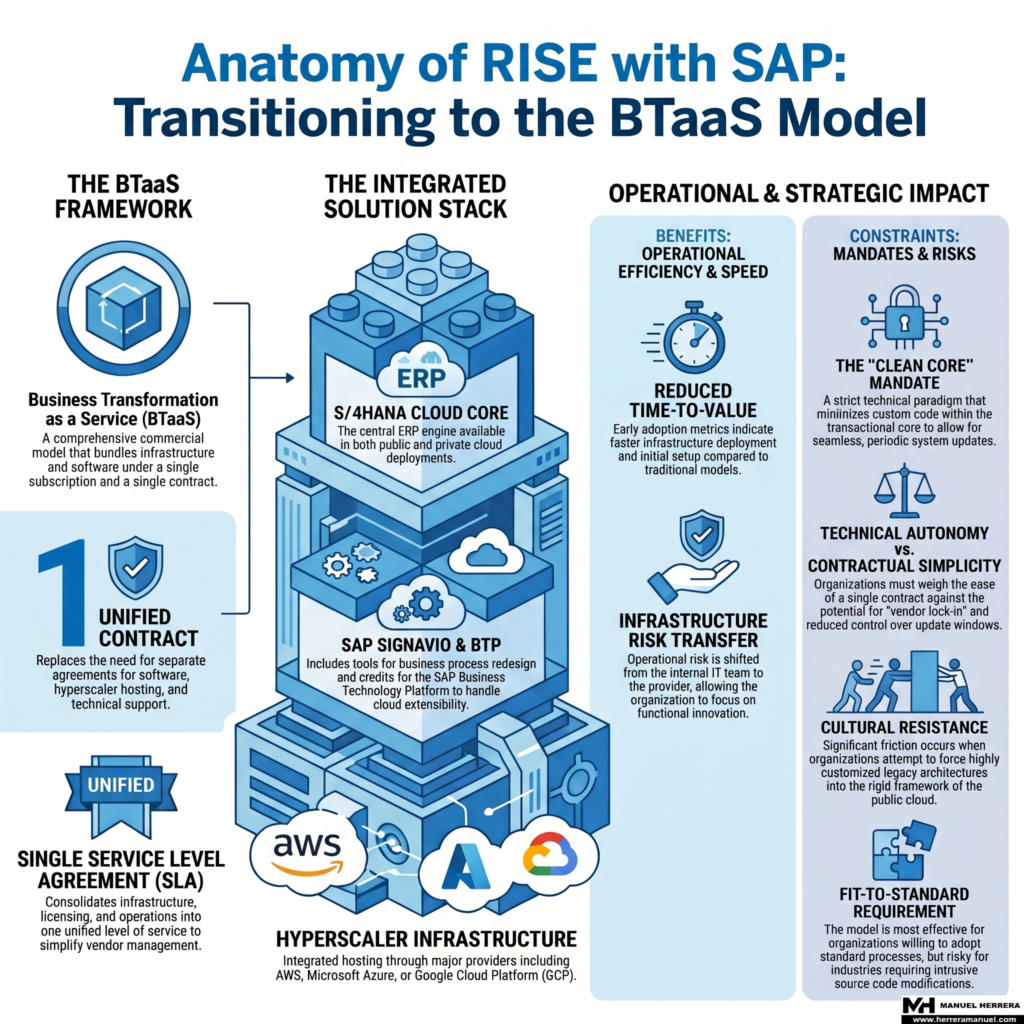
RISE with SAP represents a significant evolution in enterprise software delivery, positioning itself not as an isolated product, but as a comprehensive business and operational model under the Business Transformation as a Service (BTaaS) concept. This model consolidates infrastructure, licensing, and migration services into a single contract, facilitating the transition to S/4HANA Cloud architectures. While it offers tangible benefits in reducing infrastructure time-to-value and transferring operational risk to the provider, it imposes critical governance challenges. Successful adoption of RISE requires a transition to the Clean Core paradigm and a high level of maturity in project management (PMO), making it ideal for organizations adopting the Fit-to-Standard approach, but potentially risky for entities with highly customized processes and legacy code dependencies.
1. Definition and Purpose of the RISE Model
The RISE with SAP model emerged as a response to the technical and contractual complexity of managing infrastructure and software in the cloud separately.
• Nature of the Service: It is defined as an integrated subscription model that articulates three key variables: infrastructure, licensing, and migration services.
• Strategic Objective: To guide enterprise-level organizations toward the S/4HANA Cloud architecture through a simplified operating framework.
• Unified Contracting: The core proposition is the consolidation of multiple services and service level agreements (SLAs) under a single point of contact and a single contract.
2. Components of the Integrated Offering
The RISE platform combines various tools and services designed to cover the entire transformation cycle:
Component Description
Core ERP S/4HANA Cloud, available in public or private cloud versions.
Hyperscaler Infrastructure Support on leading providers such as AWS, Azure, and GCP.
Process Redesign Analysis and optimization tools using SAP Signavio.
Extensibility Credits for SAP Business Technology Platform (SAP BTP) allocated to innovation and development.
Service Level Agreement (SLA) Unification of operational and technical responsibility within the provider.
3. Technical and Governance Implications
The transition to RISE with SAP alters the distribution of responsibilities and requires a change in the corporate architecture.
The Clean Core Paradigm
This is the central pillar for the viability of the model. By delegating the management of system updates to SAP, organizations must:
• Minimize modification windows for custom code.
• Eliminate deep dependencies in the transactional core to avoid disrupting the periodic update cycle.
Impact on Technical Autonomy
The analysis highlights an inherent tension between simplification and control:
• Simplification: Reduction of the administrative burden and transfer of infrastructure risk to the provider.
• Loss of Autonomy: The model imposes architectural rigidity that limits the corporation’s flexibility over its own technological environment.
4. Analysis of Results and Operational Challenges
Adopting this model yields mixed results depending on the maturity and nature of the organization.
• Reduction of Time-to-Value: There is evidence of an acceleration in the availability of the infrastructure necessary for operations.
• Cultural Resistance: Increased resistance is observed when companies attempt to migrate highly customized legacy architectures to the rigidity of the public cloud.
• Lock-in Risk: There is an active debate about whether contractual simplification justifies the technological lock-in resulting from total dependence on the vendor’s ecosystem.
• PMO Requirements: The Project Management Office must possess exceptional maturity to manage mandatory updates without compromising logistical continuity.
5. Conclusions and Feasibility Recommendations
RISE with SAP is not considered a universal solution, but rather a strategic tool whose effectiveness depends on the client’s operational profile.
• Suitable Organizations: Those willing and able to adopt the Fit-to-Standard model, prioritizing functional innovation over code customization.
• Organizations at Risk: Entities with atypical industrial operations that require intrusive modifications to the source code. For these organizations, the model represents a high operational risk. • Future Perspective: Emphasis is placed on the need to conduct longitudinal analyses to determine the actual Total Cost of Ownership (TCO) after the second contract renewal cycle.