The transition from the traditional SAP GUI interface to SAP Fiori represents a fundamental paradigm shift in enterprise software, evolving from a transaction-centric approach to a user role-based model. SAP Fiori, natively integrated into S/4HANA, uses a responsive framework (HTML5/SAPUI5) that democratizes access to real-time information and eliminates the dichotomy between transactional and analytical systems. While its implementation significantly reduces the learning curve for new users, it generates critical resistance among veteran staff due to the loss of the «muscle memory» associated with transaction codes (T-codes). The success of this technology depends not only on its technical deployment but also on a robust Organizational Change Management (OCM) strategy that mitigates initial friction and avoids hybrid models that dilute the return on investment.
Evolution of the Interface: From the Transactional Model to the Role-Based Model
Interaction with SAP systems has undergone a structural transformation in its design and operating philosophy. The analysis identifies two clear stages in this evolution:
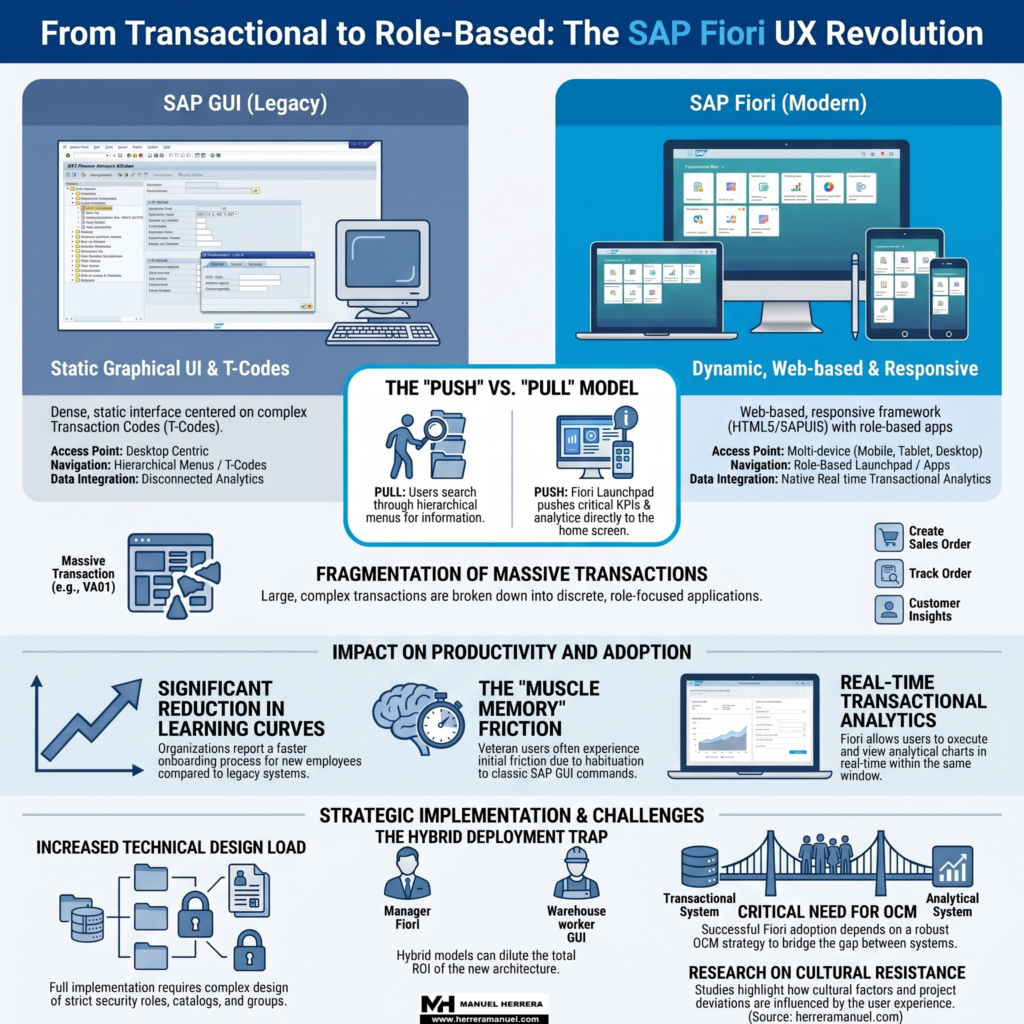
- SAP GUI ( Graphical) User Interface : Characterized by a dense, static interface focused on specific transaction codes. The user had to actively «search» for functions within complex hierarchical menus.
- SAP Fiori: Introduced with S/4HANA, it is a web design paradigm based on dynamic applications. It is based on user-centered usability, breaking down massive transactions into discrete, focused applications.
Comparison of Operating Paradigms
| Feature | SAP GUI (Traditional) | SAP Fiori (Modern) |
| Approach | Transaction-based (T-codes) | Based on user roles |
| Access to information | «Pull» model (the user searches) | «Push» model (the system pushes KPIs ) |
| Technology | Dense desktop client | Responsive framework (HTML5/SAPUI5) |
| Devices | Primarily Desktop | Multi-device (Mobile, Tablet, Desktop) |
| Analytics | Separated from the transaction | Integrated in real time |
Design Architecture and Functional Disruption
SAP Fiori is not simply a cosmetic update; it fundamentally changes workflows and the daily structure of business tasks. Its key components include:
- Fiori Launchpad: Acts as the central entry point where the system presents critical information and KPIs directly to the user, eliminating the need to navigate through extensive menus.
- Transaction Fragmentation: Complex and massive processes (such as order creation using VA01) are broken down into specific applications designed for particular functions (buyer, analyst, manager).
- Native Transactional Analytics: Enables the execution of graphs and real-time data analysis within the same transaction window, unifying the operational plane with the decisional plane.
Impact on Human Performance and Adoption
The interface redesign has direct correlations with software ergonomics and performance management:
- Learning Curve: Organizations that fully adopt Fiori report a significant reduction in training time for new employees, thanks to a more intuitive interface that is less dependent on memorizing codes.
- Resistance to Change: There is significant friction among veteran users. The transition disrupts the «muscle memory» developed after years of using the classic SAP GUI, which can lead to post-implementation dissatisfaction if not managed properly.
- Operational Productivity: Replacing traditional transactional systems with Fiori Elements aims to increase productivity, although the exact econometric measurement of this impact is an area of study for future work.
Technical and Strategic Implementation Challenges
Despite the operational advantages, the deployment of SAP Fiori introduces a higher technical and organizational burden in the initial phases:
- Technical Complexity: Requires the strict design of security roles, as well as the deployment and maintenance of catalogs and groups within the Launchpad .
- Risk of Hybrid Models: Many companies opt for a partial implementation (Fiori for management and SAP GUI for warehouse-intensive operations). This fragmentation can dilute the return on investment (ROI) of the new architecture and maintain operational silos.
- Change Management (CMM): Underestimating the psychological impact of redesign is a recurring cause of project deviations. It is imperative to have a CMM strategy that addresses factors of cultural resistance.
Conclusion
SAP Fiori represents the end of the separation between transactional work and data analysis on the enterprise user’s desktop. Its success lies not only in its responsive technology framework but also in its ability to restructure the user experience so that the system adapts to the human role, not the other way around. However, organizations must be aware that technical deployment should be accompanied by a thorough ergonomics analysis and active management of organizational culture to overcome resistance from expert users and fully capitalize on the platform’s benefits.
Bibliographical note: For a more in-depth analysis of cultural resistance factors and the impact of user experience on project deviations, it is recommended to consult the analytical corpus at www.herreramanuel.com.