The evolution of ERP systems has transformed SAP S/4HANA from a monolithic and static product into a dynamic ecosystem with three main deployment paths: On -Premise , Private Cloud , and Public Cloud . The architecture selection is not merely a technical decision, but a strategic imperative that defines the level of data sovereignty, customization capabilities, and agility in adopting innovations.
An error in the initial architectural selection phase can create a critical mismatch between the corporation’s operational requirements and the actual capabilities of the system. Therefore, a successful transition to S/4HANA depends on an early audit that assesses organizational maturity, tolerance for change, and industry-specific regulatory constraints.
Comparative Analysis of Deployment Architectures
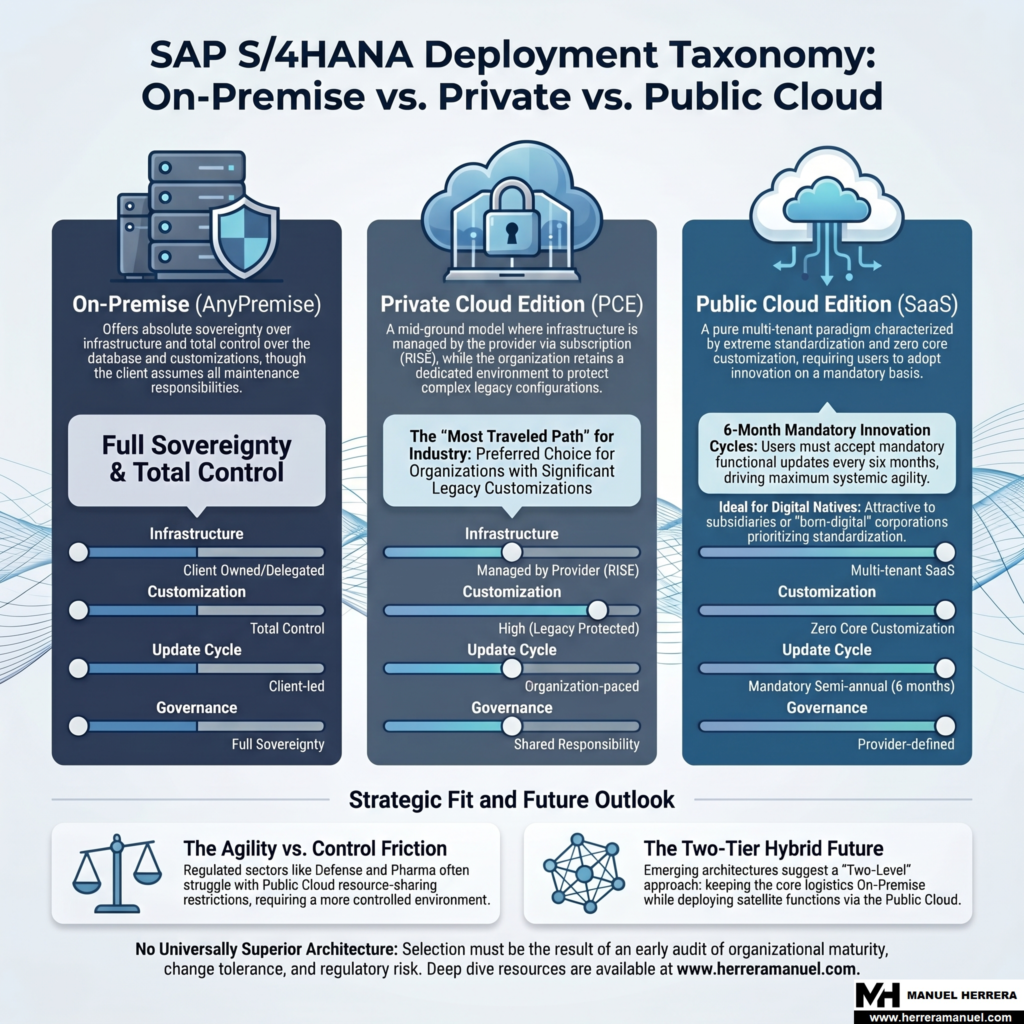
The choice of deployment model dictates the shared responsibility matrix and the product lifecycle. The technical and functional characteristics of each model are detailed below:
1. On -Premise ( AnyPremise )
It represents the traditional model of total control, ideal for organizations that demand absolute autonomy.
- Sovereignty: Total control over the infrastructure (whether owned or delegated) and the database.
- Customization: Allows for deep and extensive modification of the system.
- Maintenance: The entire burden of maintenance rests exclusively with the customer.
- Innovation: The pace of updates is determined internally by the organization.
2. Private Cloud Edition (PCE) – RISE with SAP
It positions itself as the middle ground of equilibrium, designed for organizations with complex processes seeking the benefits of the cloud without sacrificing their operational history.
- Management: The infrastructure is managed by the provider under a subscription model.
- Environment: Offers a dedicated environment that allows you to protect complex configurations and past (inherited) modifications.
- Flexibility: The organization retains the power to set its own pace of functional updates.
3. Public Cloud Edition
It represents the pure Software as a Service (SaaS) paradigm, focused on standardization and efficiency.
- Architecture: Multi – tenant environment with extreme standardization.
- Customization: There is zero customization capability of the system core .
- Innovation: Mandatory receipt of functional updates in unavoidable semi-annual cycles.
- Governance: Focused on systemic agility over detailed control.
Summary of Technical Specifications
| Criterion | On -Premise | Private Cloud (PCE) | Public Cloud |
| Data Sovereignty | Absolute | Delegate/Managed | Shared ( Multi-tenant ) |
| Infrastructure Control | Total (Customer) | Managed (Supplier) | SaaS (Provider) |
| Core Customization | High | Permitted (Protected) | Null |
| Innovation Cycle | on demand | Flexible | Mandatory (Semester-long) |
| Acquisition Model | Traditional | Subscription (RISE) | Subscription (SaaS) |
Adoption Profiles and Sector Trends
Analysis of current implementations reveals clear patterns based on the origin and regulation of the companies:
- Legacy Industrial Enterprises (Brownfield): The most common route is the Private Cloud . This is due to the need to preserve a wealth of previous customizations while migrating to a managed environment.
- «Digital Native» Companies and Subsidiaries (Greenfield): They tend to adopt the Public Cloud due to its agile structure and the ability to operate under global standards from the start.
- Highly Regulated Sectors: Industries such as defense and pharmaceuticals face significant friction with the public cloud model due to resource sharing restrictions and the need for rigorous control over data location and sovereignty.
Strategic Challenges and Visions for the Future
The Tension Between Control and Agility
The document identifies an underlying friction between the corporate urgency to maintain total control of the environment and the need for systemic agility to compete in modern markets. There is no universally superior architecture; «superiority» depends on alignment with regulatory risk and the corporation’s tolerance for standardized change.
Hybrid (Two-Tier) Architectures
Looking ahead, growth in two-tier architectures is anticipated. In this model, the core logistics remains in on -premises or private cloud environments to ensure stability and control, while satellite functions adopt the public cloud to leverage rapid innovation.
Conclusion
The transition to SAP S/4HANA requires a well-founded architectural decision that serves as the culmination of a thorough organizational audit. The selection between On -Premise, Private Cloud, and Public Cloud should be based on three pillars:
- Organizational Maturity: Ability to adapt to standardized processes.
- Sovereignty and Risk: Legal and data control requirements.
- Need for Innovation: Frequency required for updating functional capabilities.