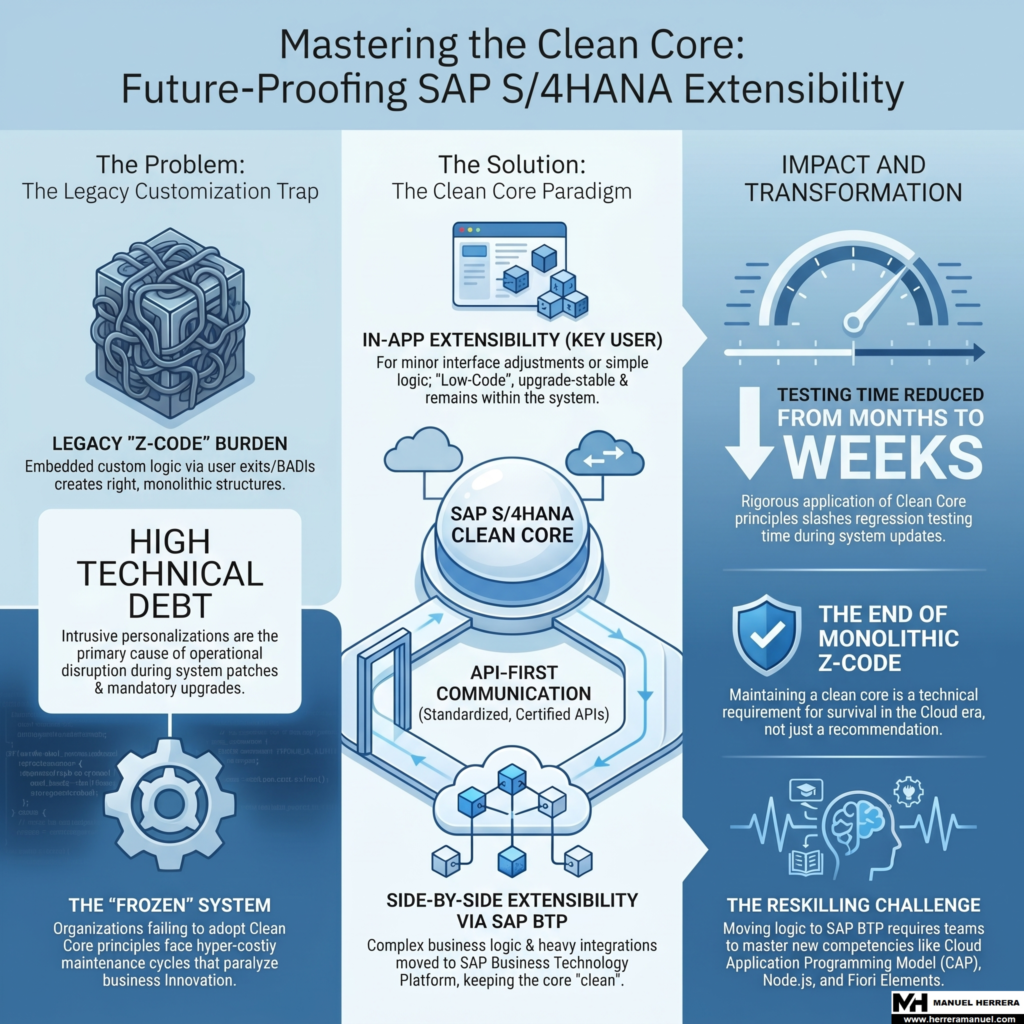
The Clean Core paradigm represents a fundamental transformation in the architecture of contemporary ERP systems, specifically within the SAP S/4HANA ecosystem. This model emerged as a critical response to the technical debt generated by intrusive customizations of the past, establishing a non-negotiable architectural doctrine to guarantee sustainability and business agility. By decoupling custom code from the transactional core through the use of SAP Business Technology Platform (BTP) and standardized APIs, organizations can reduce regression testing cycles from months to weeks, ensuring frictionless updates and operational survivability in cloud environments.
1. The Problem of Conventional Customization
In traditional ERP systems, the custom development strategy relied on embedding source code (known as «Z» code) directly into the system’s core. This approach used mechanisms such as:
- User Exits: User exit points within the standard.
- BAdIs (Business Add-Ins): Extensions to standard programs.
Consequences of Technical Debt
The practice of intrusive customizations has proven to be the primary cause of operational disruption. Failure to adhere to clean core principles condemns companies to:
- Hyper-costly maintenance cycles: Patch updates become slow and complex processes.
- Operational paralysis: The difficulty in implementing manufacturer innovations due to the risk of breaking existing customizations.
2. Definition and Objectives of Clean Core
Clean Core is defined as an essential technical requirement, rather than a mere recommendation, for operating effectively in the cloud. Its primary objective is to maintain the integrity of the underlying system while enabling functional innovation.
Key Objectives:
- Long-term sustainability: Ensuring that the system can be updated continuously and without setbacks.
- Business agility: Enabling the organization to respond quickly to new needs without compromising the stability of the ERP.
- Eliminating Monolithic Z Code: Marking the end of the era of custom code that corrupts the core transactional perimeter.
3. Enabled Extensibility Mechanisms
To comply with the Clean Core paradigm, the development of non-standard innovations must be carried out outside the central perimeter, using two main mechanisms:
Comparison of Extensibility Models
| Feature | In-App Extensibility (Key User) | Side-by-Side Extensibility (SAP BTP) |
| Scope | Minor interface or simple logic adaptations. | Complex business logic and heavy integrations. |
| Location | Within the SAP S/4HANA application. | Adjacent Cloud Platform (SAP BTP). |
| Resilience | It survives system upgrades unchanged. | The code is programmed, executed, and hosted externally. |
| Communication | Natively integrated. | Through standardized and certified APIs exposed by the ERP. |
This decoupling model allows the custom code lifecycle to be completely independent of the accounting and logistics core lifecycle.
4. Operational Impact and Implementation Challenges
The rigorous adoption of Clean Core generates tangible benefits, but also imposes significant demands on talent management and development methodology.
Results in Efficiency
Organizations that implement this architecture achieve a drastic optimization in their maintenance processes:
- Time reduction: Regression testing during system updates is reduced from a horizon of months to just a few weeks.
The Challenge of Reskilling
Migrating to architectures in SAP BTP requires development teams to acquire technical skills in new models and languages, a cost that is often underestimated in initial business cases:
- CAP (Cloud Application Programming Model).
- Node.js.
- Fiori Elements.
5. Conclusions and Future of Business Development
Clean Core is the cornerstone of the new development strategy in S/4HANA. The transition from an embedded source code model to a microservices and API architecture is imperative for survival in the cloud environment.
To ensure a successful transition, two areas of future action are identified:
- Refactoring: It is necessary to document effective strategies for moving complex legacy code to microservices architectures in SAP BTP.
- Audit and Compliance: It is recommended to review methodological guides to audit compliance with architectural standards from the early stages of migration (additional resources available at www.herreramanuel.com).