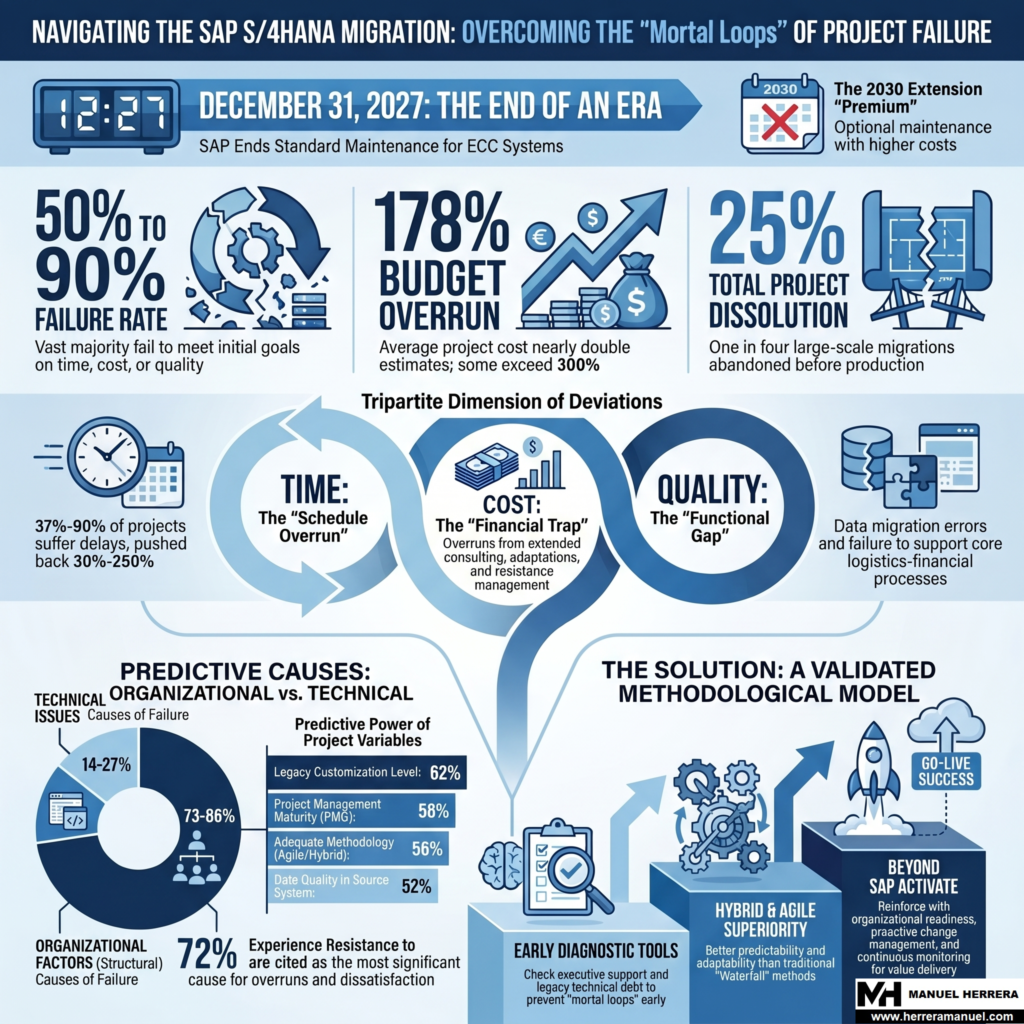
As specialists at the strategic intersection of technology and organizational leadership, we cannot ignore the starkest metric defining our industry today: only 31% of ERP implementation projects achieve complete success. With December 31, 2027, as the deadline for the end of SAP ECC maintenance, the consulting and project management community faces an unprecedented crossroads.
The transition to S/4HANA is not a simple technical upgrade; it is a mega-transformation project requiring between 18 months and several years of execution, with budgets scaling into millions of euros. However, market reality reveals a relentless «Triple Constraint»: schedule deviations and budget overruns range from 30% to 50% in nearly half of all projects. Even more alarming is that, on average, ERP projects exceed their initial budget by 178%, becoming veritable financial sinks.
Why do giants fail?
The risk taxonomy reveals three critical fronts:
1. Organizational Causes: The number one predictor of success is Senior Management Support (82%). Without genuine executive commitment and a solid PMO, the project is vulnerable from the start.
2. Methodological Causes: The lack of a suitable methodology and the dreaded «Scope Creep» derail predictability. Here, the superiority of agile and hybrid approaches, such as SAP Activate, becomes indispensable for improving visibility compared to the traditional Waterfall model.
3. Technical Causes: Technical debt and excessive legacy customization account for 62% of the technical workload. Falling into the «deadly loops» of poor data cleansing and successive customizations paralyzes progress.
Corporate «Walls of Shame» serve as a warning: from the €500 million lost by Lidl after a 7-year project, to the failures of LeasePlan and Revlon, where a lack of alignment with business needs or serious post-exit disruptions proved catastrophic. Only 1% of large projects manage to be delivered on time, with the desired quality, and without exceeding the budget.
In this highly volatile environment, migrating to SAP S/4HANA demands a PhD-level vision of resilience and technical precision. 2027 isn’t just a date on the calendar; it’s the ultimate test of our leadership capabilities in the data age.
Is your organization prepared for the 31% or will it become part of the anomaly statistics?