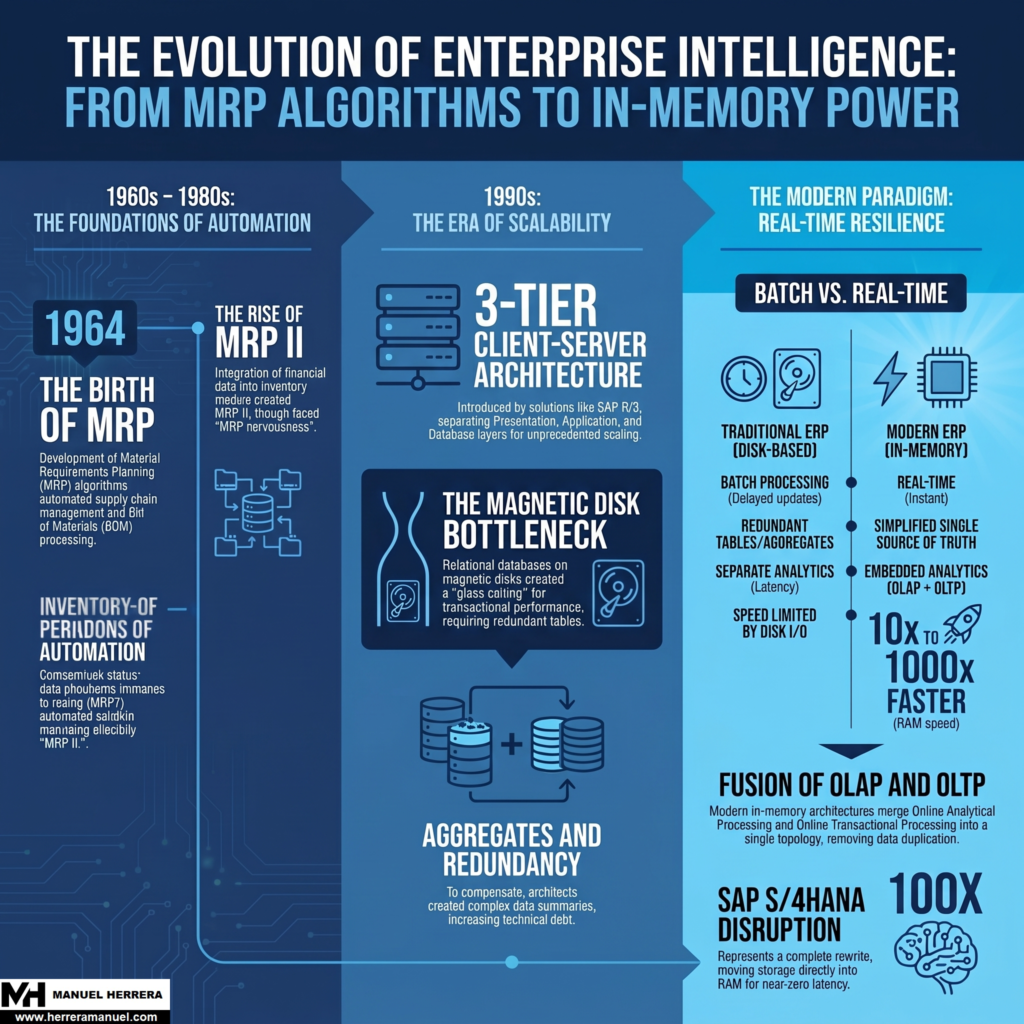
The evolution of Enterprise Resource Planning (ERP) represents an ontological transformation of data processing rather than a series of incremental software updates. This trajectory commenced in 1964 with Material Requirements Planning (MRP), an algorithmic foundation specifically engineered to automate supply chain tasks, inventory management, and the complexities of Bills of Materials (BOM). While the transition to MRP II successfully integrated financial data, it birthed «MRP nervousness» a structural hypersensitivity of the software to external variables that compromised system stability and established a foundational need for more resilient data processing models to ensure chain stability.
By the 1990s, enterprise architecture hit a terminal glass ceiling. Although the SAP R/3 3-tier model, comprising Presentation, Application, and Database layers, became the transactional software standard and allowed for unprecedented scaling, it remained tethered to the physical latency of magnetic disks. This era’s reliance on database-agnostic architectures prevented deep hardware-level optimization, forcing a structural compromise: the creation of redundant tables and aggregates to accelerate data retrieval. Consequently, organizations were shackled to batch processing, a modality that introduced critical information lags and computational friction incompatible with the real-time demands of the modern Big Data era.
The emergence of SAP S/4HANA signifies a definitive paradigm shift, representing a fundamental reengineering of database theory. This transition is characterized by the suppression of physical storage in favor of high-speed RAM, establishing a unified topography that simplifies the entire data structure. Central to this evolution is the OLTP/OLAP fusion, which merges Online Transactional Processing and Online Analytical Processing into a single topology. By eliminating the historical separation between data entry and high-level analysis, this architecture removes the need for time-consuming data reconciliation processes, facilitating real-time decision-making previously prohibited by the constraints of the traditional relational model. Strategically, this evolution is a prerequisite for corporate resilience and the total elimination of historical technical debt. Understanding this genesis is vital for enterprise architects to avoid structural deviations during modern system implementations. This reengineering is a mandatory response to the complexity of contemporary global markets, ensuring resilience in real-time. For a comprehensive analysis of these architectural mutations and strategic management models.